Pet Health, Interesting Facts, and Trivia
LitterBox Problems
Elimination Problems in Cats Can Be Tricky to Solve
By Betsy S. Sino, Courtesy of Pet Health News
When a professional animal behaviourist receives a frantic call for help from a cat owner, many times the problem involves a cat that refuses to use its litter box. The cat may have used the box faithfully for years, but for some reason, it has now taken to soiling the Oriental rug in the study. "She's doing it out of spite," many an owner has wailed. However, it's important, especially in this case, to understand that animals are not capable of acting out of spite.
Animals are also incapable of understanding why they are punished for greeting their owners who have just returned home. The owner finds urine or feces on the floor and punishes the cat, but the cat does not connect the "crime" to its punishment. Instead, the cat learns to fear its owner, which may worsen the problem. For punishment to have any meaning, the cat must be caught in the act of soiling the rug, but even then the problem may continue. The reasons for such behavior are usually far more complex than most owners realize. Fortunately, many of these problems can be corrected, but the solutions usually require patience and know how.
Spraying Behavior
There are actually two types of elimination problems that cat owners must contend with: spraying and refusal to use the litter box. Cats squat to perform their normal elimination duties, but to spray, they stand up, hold their quivering tails in the air, and release a horizontal spray of urine on a vertical surface, such as a wall or chair.
If an owner finds urine outside the litter box but has never seen the cat in the act, he or she must first determine which type of behavior the cat is exhibiting. Depending on the circumstances, the remedies vary for each type. Obviously, if urine is dripping down the wall or furniture, spraying is the problem; a puddle on the floor is of the other type.
Male cats are far more likely to spray than females, but either sex can develop the habit. In many cases, spaying or neutering helps resolve a cat's spraying habit; spraying is often performed to mark territory, and this urge to mark is lessened with neutering. Neutering may mellow the behavior of a male cat at any age, and spaying is effective in curbing the habits of a female cat that sprays only during her heat cycle. If a female sprays year-round, the problem may be more difficult to correct.
If a spayed or neutered cat persists in spraying, the owner must try to determine why. Some experts suggest that spraying behavior is linked to the number of cats in a household. The more cats, the more likely spraying behavior will be a problem. Sometimes, when a new cat is introduced to the household, the veteran resident begins spraying. Consequently, limiting the number of cats in the household may prevent spraying problems.
Another theory is that some cats spray when they see a strange cat. This applies to indoor cats that sit in window ledges and watch outdoor cats saunter by. Some cats respond this way to anything new and unusual, even to a new piece of furniture in a familiar room. In these cases, controlling the cat's exposure to new objects may help control spraying. If a cat sprays whenever it sees a strange cat outside, restrict its access to the window. If it sprays in response to a strange object in the house, do not allow it to remain unsupervised in the same room with that object.
If the cat has favored a particular spot, try removing the urine scent to make the area less attractive. Try placing the animal's food and water at the spot, or treat the area with commercial repellent. Avoid using products containing ammonia to remove the scent. Urine contains ammonia; the ammonia scent may continue to attract the cat.
If all else fails, some veterinarians will recommend short- term drug therapy to help alter the spraying cat's behavior. But according to Victoria L. Vioth, D.V.M., Ph.D., the director of animal behavior at University of Pennsylvania School of veterinary Medicine, prescribing drugs for this problem should be done cautiously. Therapy should be calculated for the individual cat, and it should cease after three months to determine its effectiveness.
Litter Box Problems
The remedies for cats with litter box problems are similar to those used to correct spraying. The refusal to use the litter box is usually the result of some type of stress in the cat's life. Before concluding immediately that the problem is a behavioural one, though, have the cat examined for possible health problems that may be causing its change in behavior.
Many cats will not use the litter box if the litter is dirty or if other cats are using its same box. The solution here is simple: Clean the litter box daily and provide the cats with multiple litter boxes. Better yet, get an automatic litter box that cleans itself so your cat's privy is always pristine.
My cat actually uses two litter boxes for two purposes. She prefers the "outside" box (on a glassed-in patio) for her bowel business and the inside box (in the bathroom) for her urination. This is very convenient for me, but entirely her own choice. You can see that if ONE cat uses at least two boxes, multiple cat households may need several.
Sometimes a cat simply dislikes the litter. Many cats are repelled by perfumes or deodorizing pellets found in litter. If the cat won't use the litter box, try different types of litter. Perhaps one will have the right texture and scent to bring the cat back to the box.
Cats that have been de-clawed are sometimes even pickier than cats with normal paws. The litter tends to "stick" to the nubbed-foot hairs and irritates some cats. It is even more important to find an "acceptable" litter for these cats or a solution with NO litter.
Do you know that there is actually a way to train a cat to use your own toilet? Cats instinctively like to eliminate over water. Wild cats actually climb trees and sit on branches over rivers and creeks to eliminate. I had a cat years ago that taught herself how to sit on the toilet seat over the bowl and do her business with no training from me at all. However, few domestic cats figure out how to use a toilet without help. There is now a complete toilet training kit available that introduces your cat to the theory and helps them become habitual toilet-users. This is sometimes the answer to a nightmare for a cat owner whose feline companion refuses the litter box.
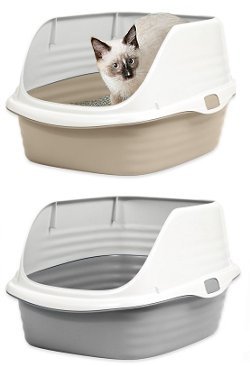
Location can be another cause of litter box problems. Most cats are modest and prefer to do their business in solitude and peace. If the litter box is in the center of the living room or next to the washing machine, chances are it won't get much use. Put it in a nice, quiet corner. Or use a covered litter box. It is more private regardless of location.
If it appears that a cat's behavior cannot be corrected by litter box alterations, a more in-depth look is in order. Most cats will dig in litter material, whether indoors or out, before eliminating. According to Dr. Voith, if an owner watches for this behavior and interrupts it before the cat eliminates, the cat may learn to change its behavior. Ditto if a dog or child is interrupting elimination time.
Altering this behavior may take some time. As with spraying, determine where the cat's favorite elimination spots are and try changing these to feeding areas after eliminating the odor in that area.
If the cat continues to eliminate in a thoroughly cleaned location, it is exhibiting a strong preference for that spot. Use this to your advantage. Try covering the area with plastic, a material few cats enjoy digging in. Place the litter box on top of the plastic. If given the choice, the cat will probably choose the litter box over the plastic when nature calls, because that is where it can perform the necessary digging rites. If this is successful, gradually move the box every day a few inches toward the spot where you want it to be.
The gradual "move the box" method will take time, and yes, it is inconvenient. However, the results can be well worth the trouble. Dr. Voith reminds her clients that cats will probably not use the spot while the owners are in the room, so it's important to remove the box when there are people in the room. When the room is empty, place the box back on the animal's favorite spot and allow the cat access to it.
Be Patient
Creativity is the key to correcting behavior problems in cats. The process requires a sound understanding of natural feline behavior and the patience of a saint.
As Dr. Voith stresses, violent punishment is not the answer when dealing with elimination problems or any type of animal behavior problem, for that matter. Although an owner swears to seeing guilt in an animal's eyes when finding urine or feces on the carpet, fear is more likely the emotion the animal is exhibiting.
The more productive, and successful, method is behavior modification based on the cat's own view of the world. Sometimes this involves assistance from a qualified behaviorist who can size up the problem and prescribe an appropriate-and humane-plan for readying that problem. Investing a little patience in this process now can provide years of happy pet ownership in the future.